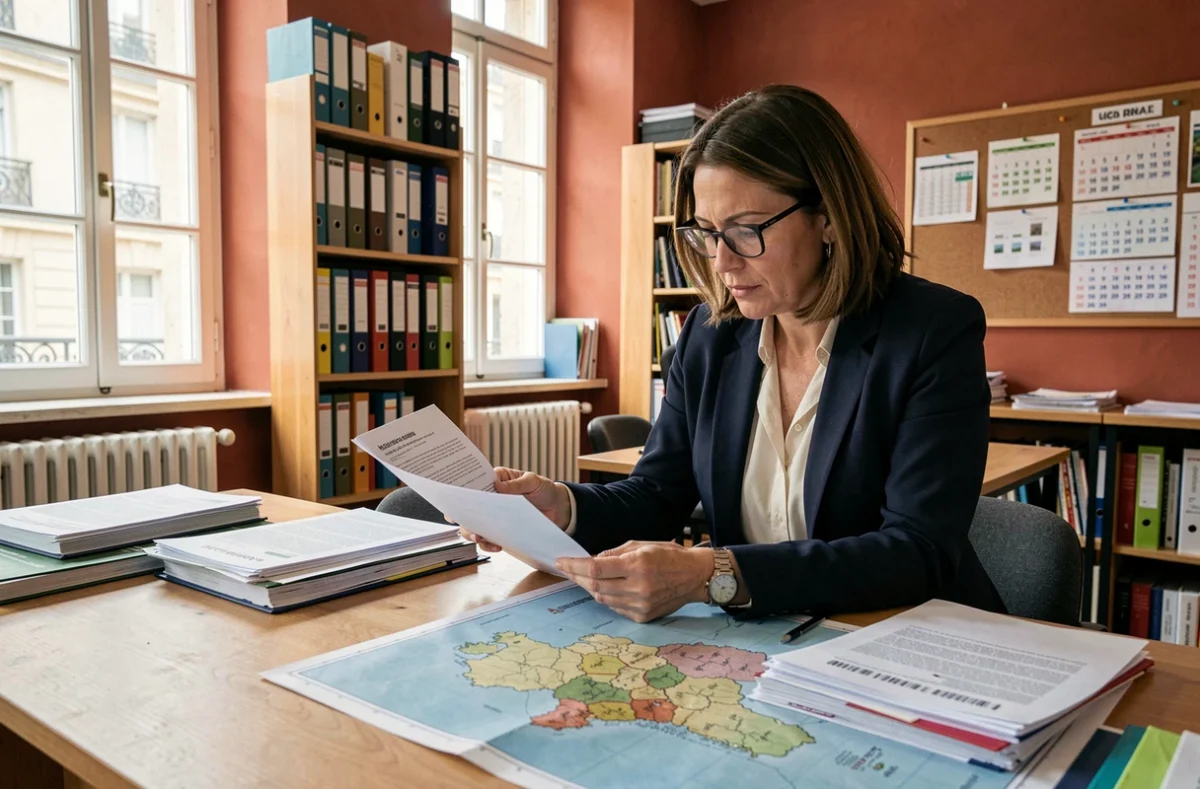
When we talk about Convergence in the Bordeaux academy, we are primarily referring to a professional messaging system accessible via a browser. Every staff member of the academy, whether a teacher, administrative staff, or technical agent, has an individual email address created from the rectorate’s management databases. This address follows a standardized format ([email protected]) and serves as the official channel for professional exchanges within the National Education system in this academy.
Convergence and academic webmail: why two terms for the same service
You may have read “webmail,” “webmel,” or “Convergence” without knowing if these words refer to the same thing. The answer is simple: Convergence is the name of the web interface for academic messaging. The term “webmel” (or “webmail”) refers to the principle of accessing emails from a browser, without software installed on the computer.
Specifically, when you type courrier.ac-bordeaux.fr into your browser, it is the Convergence interface that appears. It allows you to read, compose, and organize your messages, as well as manage a calendar and an address book. It is a unique portal, not just a simple email reader.
This distinction matters because the same academic email account can be accessed in two ways: either via Convergence in the browser, or via an email client (Thunderbird, Outlook) configured with IMAP or SMTP. The convergence of the Bordeaux academy thus encompasses a broader service than just reading emails.
Scope of the Bordeaux academy: five departments, not just the metropolitan area

One point that many new staff discover late: the Bordeaux academy covers five departments. It includes Gironde, Dordogne, Lot-et-Garonne, Landes, and Pyrénées-Atlantiques. Bordeaux is not just a city here; it is the seat of an extensive academic district.
This academy is part of the Nouvelle-Aquitaine academic region, alongside the academies of Limoges and Poitiers. The academic region is a level of coordination, but each academy retains its own digital tools. In other words, a teacher transferred from Poitiers to Bordeaux changes their email address and portal.
This division has a direct practical consequence: the databases that feed the creation of Convergence accounts are managed by the Bordeaux rectorate. When changing assignments between departments within the academy (for example, from Pau to Périgueux), the address remains the same. However, a change to another academy involves a new address.
What Convergence Bordeaux includes beyond messaging
Reducing Convergence to an inbox would overlook part of the service. The interface integrates several additional modules:
- A professional calendar that allows you to create events, send invitations, and share your availability with other staff members of the academy.
- An address book linked to the academic directory, useful for quickly finding a colleague’s contact details without knowing their exact address.
- A system of customizable folders to organize messages by project, institution, or priority, in addition to default folders (inbox, sent, trash, spam).
Convergence also coexists with other institutional tools. The Arena portal, for example, provides access to business applications (administrative management, human resources, educational tools). Arena and Convergence share the same authentication, but serve distinct functions. Logging into one does not automatically grant access to the other without explicit navigation.
Identifiers and password: the most frequent blocking point
The majority of difficulties encountered by users concern authentication. Email identifiers are automatically assigned when taking up a position. They follow a logic specific to the National Education system and do not always correspond to what one might expect.
The identifier generally takes the form of the first letter of the first name followed by the last name. In case of homonymy, a number is added. The initial password is set by the system, and changing it at the first login is a step that should not be postponed.
In case of forgetting, a reset utility is accessible from the login page. It requires having previously provided a phone number or a personal backup email address. Without this precaution, the only option remains to contact the IT support service of the rectorate.
New staff: a creation delay to expect
If you have just arrived in the Bordeaux academy, your academic address is not available on the day you start your position. The account creation may take a few days after the management services update the databases. This delay varies and is not unusual.
Accessing Convergence from a phone or tablet
Convergence is a web application, which means it works from any browser, including on mobile. The interface adapts to the screen size, although the experience remains more comfortable on a computer for managing large volumes of messages.
The other option is to set up an email client on your phone (the Mail app on an iPhone, Gmail on Android, or any compatible app). The IMAP and SMTP settings of the Bordeaux academy allow for this configuration. The advantage: receive real-time notifications without opening the browser. The disadvantage: the calendar and address book modules of Convergence are not automatically synchronized with all clients.
The academic messaging system remains a daily tool for the vast majority of staff in the academy. Understanding that Convergence goes beyond simple webmail, that the scope of the academy extends well beyond the Bordeaux metropolitan area, and that authentication deserves particular attention from the start, are three points that help avoid the most common blockages.