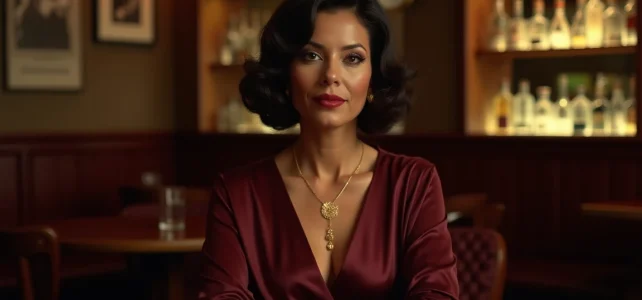
When searching for information on Julianna Farrait, her name almost systematically links to Frank Lucas, the drug lord from Harlem. She generates almost no standalone results. This narrative dependency says something specific about how her image has been constructed, not by her, but by the criminal and cinematic narrative surrounding her.
Julianna Farrait and the Visual Fabrication of the Frank Lucas Myth

The role of appearance in the construction of a criminal legend is often underestimated. Frank Lucas wasn’t just selling heroin in Harlem during the 1960s and 1970s: he was selling a lifestyle. And Julianna Farrait was a cog in this staging.
Read also : Discover the best Stremio addons in French to enhance your streaming
Originally from Puerto Rico, she married Frank Lucas in 1967. From then on, she accompanied the gangster in his public appearances, wearing outfits and furs that contributed to the couple’s ostentatious image. The luxury gifts they exchanged became recurring elements in the media narrative surrounding Lucas.
Farrait was not just a mere background figure. She actively contributed to the social showcase that Lucas maintained to bolster his reputation in the scene. This visual positioning, long before the era of social media, functioned as a tool of power. A more comprehensive profile on Frank Lucas’s wife according to Wikipedia allows us to gauge the extent of this daily involvement.
You may also like : Discover the exact height of Myriam Seurat, leading television journalist
Farrait in American Gangster: Real Character vs. Movie Character

The film American Gangster, released in 2007 with Denzel Washington as Frank Lucas, has permanently fixed Julianna Farrait’s image in the collective imagination. The character of Eva, played by Lymari Nadal, is directly inspired by her. The problem is that this cinematic version has almost entirely replaced the real person in online searches.
Here we find a classic mechanism: fiction absorbs reality and becomes the main reference. The content circulating today about Farrait heavily borrows from the film’s script rather than from direct biographical sources. Popular formats (short videos, compilation articles) reproduce this romanticized version without questioning it.
This shift has concrete consequences. When you type “Julianna Farrait” into a search engine, the results predominantly lead to secondary narratives, compilations, or content derived from the film. Verifiable information about her own life remains scarce.
What the Film Chose to Show (and Ignore)
American Gangster emphasizes the glamorous dimension of the Lucas-Farrait couple: the parties, the fur coats, the boxing match scene where Frank Lucas draws attention through his ostentation. The film portrays Eva/Julianna as a seductive and loyal woman, but does not delve into her concrete role in the organization.
In reality, Farrait herself had run-ins with the law. This aspect of her journey is rarely highlighted in mainstream versions of the story. The narrative prefers to confine her to the role of a devoted wife, which suits the gangster-centered storytelling.
Life of Julianna Farrait After Frank Lucas’s Fall
Frank Lucas was arrested in 1975 and subsequently convicted of drug trafficking. His cooperation with federal authorities allowed him to reduce his sentence, but the couple’s life turned upside down. Julianna Farrait went through this period with relative media discretion.
The information available about her life after Lucas’s incarceration is fragmentary. It is known that the couple had several children and that Farrait remained connected to Lucas for decades. Frank Lucas passed away in New Jersey.
- Farrait maintained a low profile after Lucas’s convictions, away from the media circles that had made the couple famous
- Her own judicial history, although documented, remains poorly detailed in sources accessible to the general public
- The bulk of what is found online about her comes from content produced after the film’s release in 2007, which heavily skews the actual timeline
The majority of current sources reconstruct her journey based on the film, not the other way around. This is a point that curious readers should keep in mind when consulting pages dedicated to Julianna Farrait.
Why Wikipedia and Online Sources Struggle to Document Farrait
On Frank Lucas’s Wikipedia page, Julianna Farrait (sometimes spelled Julie Farrait) appears in the biographical section as his wife, married in 1967. The treatment is minimal: a few lines, no dedicated page in French.
This documentary void is not trivial. It reflects a structural bias in the coverage of female figures associated with organized crime. The wives of famous gangsters rarely exist as standalone subjects in encyclopedias or press archives. They appear as side mentions, in the “personal life” paragraph of an article dedicated to their husband.
A Portrait Reconstructed by Fragments
To document Farrait reliably, one must cross-reference heterogeneous sources: contemporary press articles, court records, interviews with Frank Lucas himself (notably the one published in the American press that inspired the film). No standalone biography exists to date.
Reactions vary on this point depending on the sources consulted: some describe her as a full-fledged actress in the Lucas empire, while others see her as a passive figure swept along by events. The truth likely lies somewhere between these two extremes, but the absence of direct testimony from Farrait makes any definitive conclusion risky.
- No dedicated Wikipedia page for Julianna Farrait in French or English
- The only widely circulated photos come from court records or film-related captures
- Recent content (TikTok, Instagram) recycles the same anecdotes without providing new material
The Farrait case illustrates how a real person can become trapped in a narrative they did not write. Between the Harlem gangster, the film with Denzel Washington, and the algorithms that favor derivative content, Julianna Farrait remains a figure whose portrait depends on sources she never controlled. For now, it is cinema and the judicial archives of Frank Lucas that provide the material.